 Close
Close

Why collaboration is needed now more than ever for Surrey to thrive
March 30, 2026
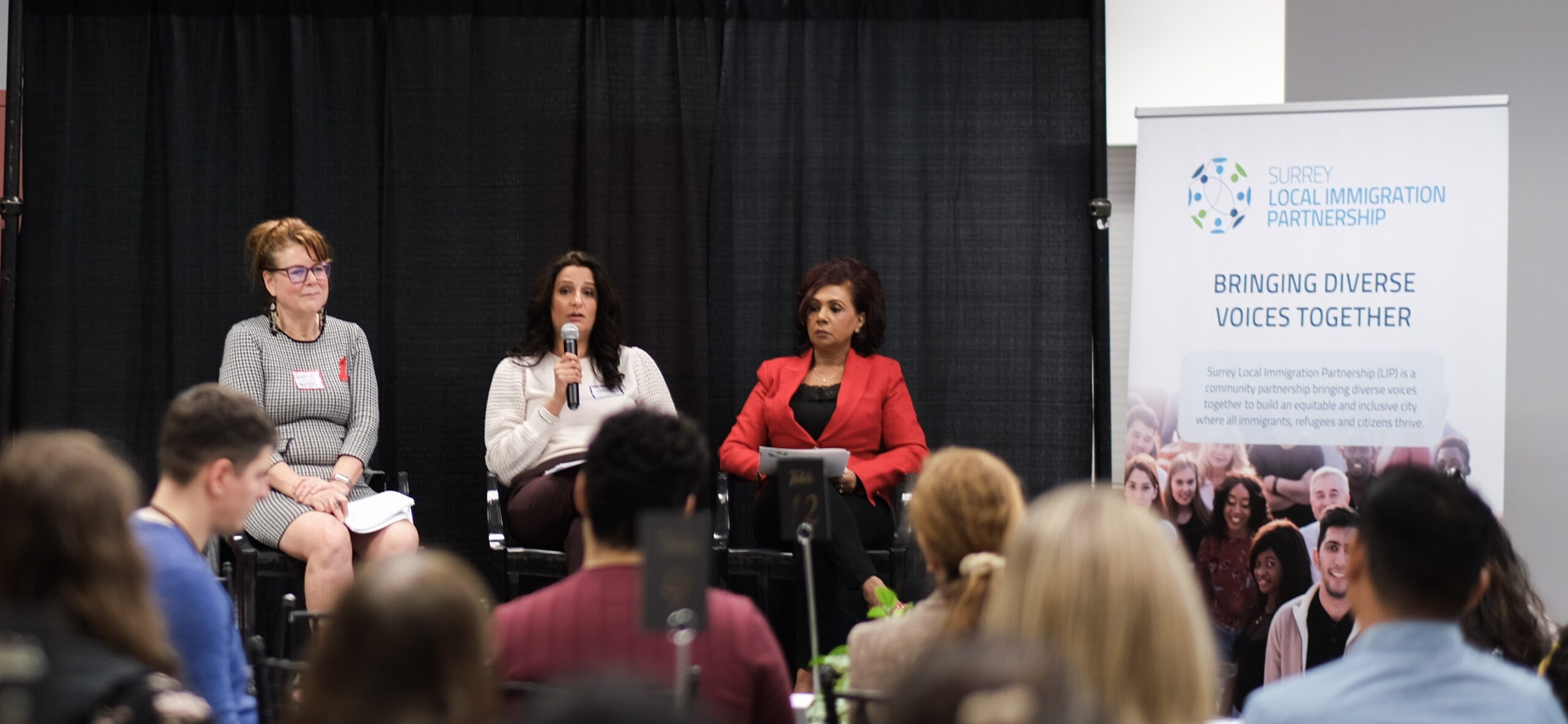
Amid shifting immigration policies and tightened funding in Canada’s settlement sector, leaders say the growth of multicultural communities like Surrey will depend on stronger collaboration and shared resources. During a panel discussion titled Beyond Scarcity – Collaboration as New Currency, community, business, and First Nations leaders emphasized the urgency for employers and immigrant-facing organizations to work together.
Neelam Sahota, Co‑Chair, Surrey LIP, and Chief Executive Officer, DIVERSEcity Community Resources Society, moderated the panel discussion as part of the Surrey LIP Community Forum. She urged the panellists to examine how cross-sector partnerships are adapting and what a ‘win-win’ outcome would be for everyone.
Matching skilled newcomers to jobs that require their skills would be a win-win collaboration, said Indra Bhan, Chief Operating Officer, Surrey White Rock Board of Trade, highlighting how many newcomers arrive with real skills and trade experience but sometimes face challenges, such as getting their credentials recognized or learning how workplaces operate in Canada. “When settlement organizations understand what employers actually need, and when employers are willing to offer mentorship or some bridge training, that’s when things really start to work.”
Untapped opportunities for partnership
Bhan identified four key areas where employers could partner with settlement agencies to make it easier for newcomers to find work, fill critical labour gaps, and smooth their integration journey in Surrey.
-
Earlier engagement with newcomers and employers connecting with settlement agencies earlier, even during orientation, would unveil labour market needs and career pathways.
-
Sector-specific training partnerships, led by businesses working with non-profits to shape short, targeted training programs that directly match current job openings.
-
Work-integrated learning (internships, mentorships, and paid placements) would also reduce hiring risk for employers while giving newcomers the Canadian experience they often need.
-
Since SMEs make up most of Canada’s economy, creating simple, practical partnership models for SMEs would unlock significant opportunities.
How Surrey partners can better align their goals
Bhan also said that collaboration would work better if alignment between organizations led to a shared outcome, built on the following concepts:
-
A clear definition of success: Whether it’s faster employment for newcomers, filling critical labour shortages, or stronger economic growth.
-
Align around data and labour market realities: Regularly share workforce data, hiring trends, and community needs to ensure programs are responsive.
-
Clarity of roles: Clarify which partner leads what role, removing overlapping responsibilities.
-
Consistent communication: Ongoing tables/working groups where partners can adjust quickly as conditions change.
-
Build relationships — not just projects: Strong relationships lead to faster decisions; barriers are resolved informally before they grow.
Collaboration needs to become part of Canada’s social fabric
To meet the evolving community needs amid shrinking resources, collaboration can no longer be based on relationships between individuals, said Daljit Gill-Badesha, Chief Executive Officer, Affiliation of Multicultural Societies and Service Agencies of BC (AMSSA).
“In the settlement sector, collaboration has always been essential. Newcomers arrive with complex and interconnected needs — housing, employment, language, childcare, and health. No single organization can meet all of those needs alone. What is changing now is the level of intentionality required,” she explained.
Gill-Badesha identified three key changes happening concerning collaboration:
-
Collaboration is moving from projects to ecosystems: The real question is not “How do organizations collaborate?” but “How do we design systems that allow collaboration to happen naturally?”
-
Move from information ownership to information sharing: A system cannot improve if the knowledge inside it stays siloed. Systems in Canada are set up to compete with each other, not to collaborate.
-
Include equity in decision-making: Grassroots organizations and small centres — particularly those led by immigrant and racialized communities — often hold the deepest trust with communities, yet aren’t always present where strategy is shaped.
Collaboration between organizations needs to improve urgently, added Gill-Badesha, noting that such efforts would require normalized transparency across sectors, issue-based collaboration across jurisdictions, and building relationships that make systems function well.
Transforming Indigenous engagement for stronger partnerships
While focusing on newcomer integration into communities, involving Surrey’s Indigenous Peoples would also go a long way in building partnerships, said Valerie Cross, Executive Counsellor, Tsawwassen First Nation.
“For too long, engagement happened only when a project needed approval. Municipalities would reach out late in the process, under tight timelines, and often with predetermined outcomes. That approach caused frustration on all sides and limited the potential for shared understanding and shared benefit. Today, forward-looking organizations understand that effective Indigenous engagement begins long before any formal consultation process. It begins by showing up—at community events, cultural celebrations, and gatherings—without an agenda except relationship-building,” she added.
Cross explained that the core mission concerning Indigenous engagement needs to be reconciliation-centred, in line with the Truth and Reconciliation Commission’s Calls to Action and the United Nations Declaration on the Rights of Indigenous Peoples. Key strategies would include:
-
Combating denialism with truth by actively rejecting residential school denialism.
-
Recognize that First Nations are distinct governments with their own laws, cultures, and traditions, and that BC’s 200+ distinct communities have diverse, overlapping, and unique needs.
-
A willingness to learn about local history, governance, and trauma.
-
Invest in long-term relationship building and support frameworks for equity.
-
Co-develop projects and processes with Indigenous partners, from planning to completion.
Cross added that to strengthen partnerships with Indigenous communities, organizations could identify the traditional territory of the specific First Nation(s) on whose land they are working; learning about their history and the ongoing impacts of colonization; establish direct contact and build relationships before asking for partnership; and develop genuine partnerships rather than just managing legal risks.
The panel discussion was part of efforts taken at the Surrey LIP Community Forum to contribute ideas and commitments to shape the 2026–2027 Surrey LIP Action Plan. Participants also attended a 90-minute workshop titled Working Together for Collective Success, led by JP Baker from Vantage Point. The session introduced practical tools for navigating organizational collaboration, including understanding partnership models, identifying conditions for successful collaboration, and recognizing opportunities and challenges of working across sectors.