 Close
Close


Mapping healthcare access in Surrey, BC
February 5, 2026
Reaching healthcare facilities within a reasonable time is a stretch for many, according to new research
Depending on where you live, getting the care you need can mean a much longer journey. Research from Surrey, British Columbia shows that healthcare access is not equal across the city, and that some communities face much longer travel times than others.
Despite recent investments in public transit and healthcare infrastructure, many residents still struggle to reach essential healthcare services within a reasonable time. These challenges are especially pronounced for populations that already experience social and economic disadvantages.
What the study examined
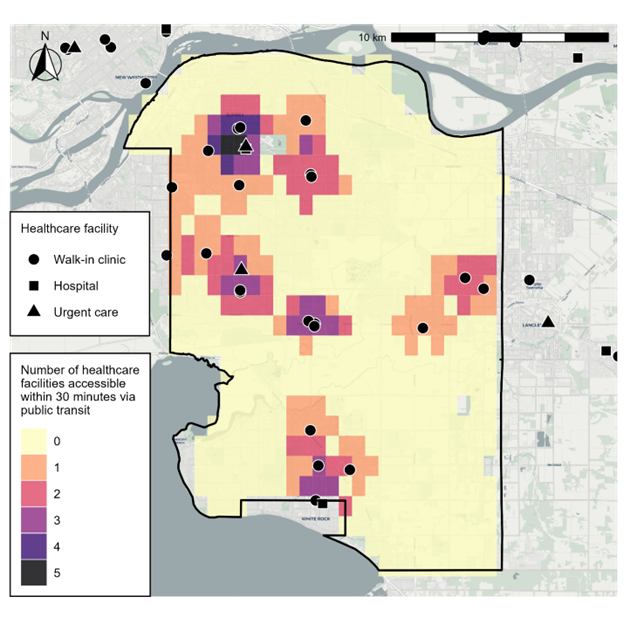
This study uses population data from the 2021 Census, combined with healthcare facility locations and public transit scheduling data from 2024, to estimate how many healthcare facilities Surrey residents can reach within a 30-minute public transit trip.
Key findings
- Overall, 56% of Surrey residents can reach at least one walk-in clinic, hospital, or urgent care centre within 30 minutes by public transit.
- Walk-in clinics are the most accessible, followed by urgent care centres and hospitals.
- Older adult (65+ years) racialized communities living in low-density neighbourhoods (<400 people per square kilometre) are among the least likely to have timely access to care.
These gaps matter. When people cannot reach care easily, they are more likely to miss or delay appointments. Over time, delayed care can worsen chronic conditions, increase emergency department visits, and lead to more hospitalizations — outcomes that are not only harder on individuals and families, but also far more costly than timely access to preventative care.
Why equitable access matters for a growing city
Surrey is one of Canada’s fastest-growing and most diverse cities, yet population growth is outpacing investments in transit and healthcare infrastructure in many areas.
New projects like the Cloverdale hospital, the King George Boulevard Bus Rapid Transit (BRT), and the Surrey–Langley SkyTrain could make it easier for people to get where they need to go. But for those who rely on public transit the most, it will matter where these services are built and how well they connect to neighbourhoods.
To better understand where gaps remain, this study mapped neighbourhoods with the lowest levels of access to healthcare facilities within a 30-minute transit trip.

Closing the gaps
Reducing inequities in healthcare access will require coordinated action across sectors. Steps taken in collaboration with city planners, public transit authorities, and healthcare providers could make a meaningful difference. This might include:
- Investing in high-frequency public transit in peripheral and low-density neighbourhoods,
- Locating new healthcare facilities in neighbourhoods with limited access, and
- Strengthening community-based programs that help residents navigate healthcare services.
Focusing planning efforts on underserved areas can improve access for populations most at risk of missing or delaying care, and help prevent avoidable strain on hospitals and emergency services.
About the research
This research is financially supported by Housing, Infrastructure, and Communities Canada and contributes evidence to inform Canada’s first National Infrastructure Assessment. It applies advanced computational methods to identify inequities in access to essential infrastructure.

This study is led by Amrit Tiwana, a doctoral researcher in the Urban Predictive Analytics Lab at UBC’s School of Community and Regional Planning. Learn more about Amrit’s work on the UBC Graduate Studies Student profile.
The findings from this research are now published. Read the full paper here.