 Close
Close


How communities in Canada can better retain skilled migrants
January 20, 2026
Retention of skilled immigrants is an issue we need to address, according to the Leaky Bucket 2025 Report
One in five migrants to Canada reportedly leaves for greener pastures within 25 years of landing, a figure that peaks within five years of their arrival, states The Leaky Bucket 2025 Report, which sheds light on retention trends in highly skilled and in-demand occupations.
The report also provides insights on how to encourage more talented immigrants to stay in Canada. Here below are the key suggestions.
Settlement supports would help highly skilled immigrants
While Canada’s immigration system is designed to select highly skilled, highly educated immigrants to support long-term economic growth, it is these individuals who migrate onwards.
One in 10 migrants with advanced degrees is likely to leave Canada within five years of arrival, one in four within 15 years, and one in three within 25 years
- 35% of migrants in senior positions in critical sectors like construction, health care, trade, and business leave within 25 years of arrival
- Roughly 25% of migrants who work as scientists, artists and health care professionals depart within 25 years of landing
Together, these professionals drive innovation, shape strategic vision and deliver care to Canadians.
Focusing settlement services like bridging programs, licensing pathways, and personalized settlement plans on the first three to five years of immigrants’ lives in Canada would reduce onward migration risk among highly skilled immigrants.
The stakes are especially high in occupations with both high immigrant representation and high onward migration rates.
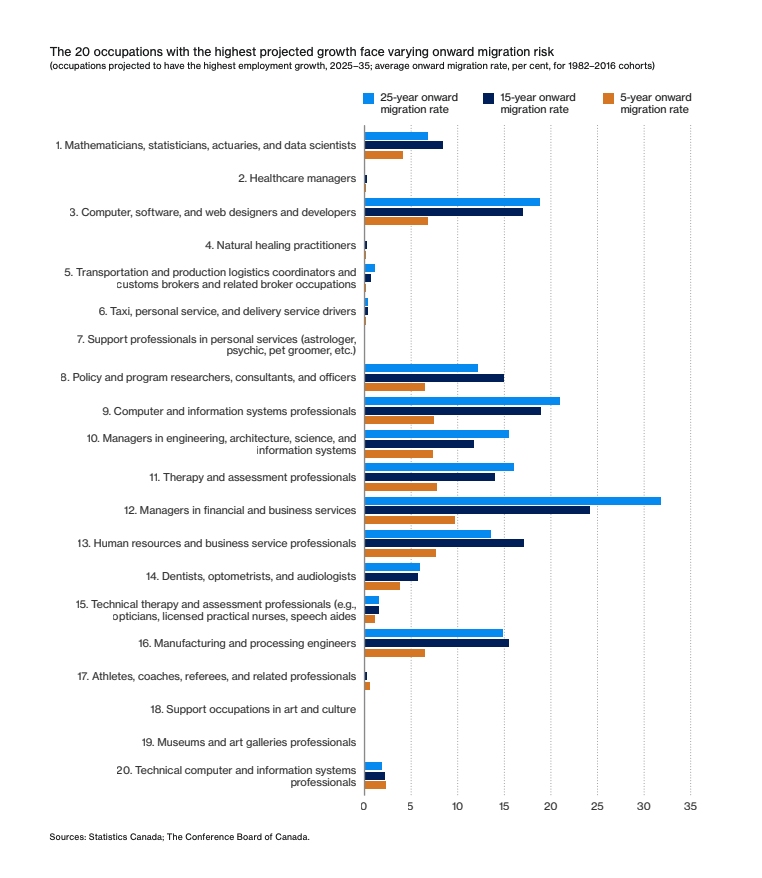
The 20 occupations with the highest projected growth face varying onward migration risk (Sources: Statistics Canada; The Conference Board of Canada)
Enhanced employer recruitment capacity would help retain immigrant talent
Measures taken in collaboration with employers would help curb the high onward migration rates of immigrants who experience unemployment or stagnant earnings while in Canada. Steps to ensure that immigrants enter the workforce quickly and thrive in Canada could include:
- Strengthening retention by creating welcoming workplaces
- Offering personalized settlement plans
- Providing in-house support such as mentorship and career development
Such initiatives are especially effective in smaller communities and help improve retention. Understanding who is leaving and why would go a long way in retaining talent.
A retention strategy in high-growth occupations would help meet labour market needs
Migrants employed as healthcare managers, technical therapy and assessment specialists (e.g., paramedics), and transportation and production coordinators are among the most likely to stay in Canada.
However, those in STEM, research, finance and manufacturing have among the highest onward migration rates. Steps taken to retain them could include:
- Retention incentives for employers, enhanced credential recognition and career pathways
- Stronger employment-related settlement services for in-demand occupations
- Recruitment, job matching, hiring, and training, particularly in the first three to five years after landing
Onward migration is highest where occupational demand is the highest, and a strategy towards retention would help address this issue. This is also the case among immigrants with stagnant or declining earnings: a connection that is especially pronounced among those with graduate degrees.
A national retention policy would provide insights into where immigrants are leaving from
The Atlantic region has the highest onward migration rates in Canada: more than one in three migrants choose to pursue opportunities overseas. British Columbia and Quebec follow, while the Prairies, Ontario, and the territories tend to retain immigrants more successfully. British Columbia, Ontario and New Brunswick also have relatively low inter-provincial migration rates, choosing to directly move overseas to pursue opportunities.
In this context, a retention policy would:
- Provide policy-makers with a deeper understanding of who is leaving, and from when and where
- Contain data on the education, skills and earnings growth of onward migrants. enabling policy-makers create the retention efforts that are needed for better economic growth
- Set targets, track performance and guide immigration policy beyond selection alone
Canada has acknowledged retention as a part of its broader immigration policy, one that would consider in-demand roles in Canada, and could help mitigate onward migration risk in highly educated immigrants. With reduced immigration intake in the coming years, Canada would need to effectively retain immigrants to meet economic, social and humanitarian goals.