Close
Close


Hospitality dynamics experienced by West Central African immigrants in Metro Vancouver
February 23, 2026
African Diaspora
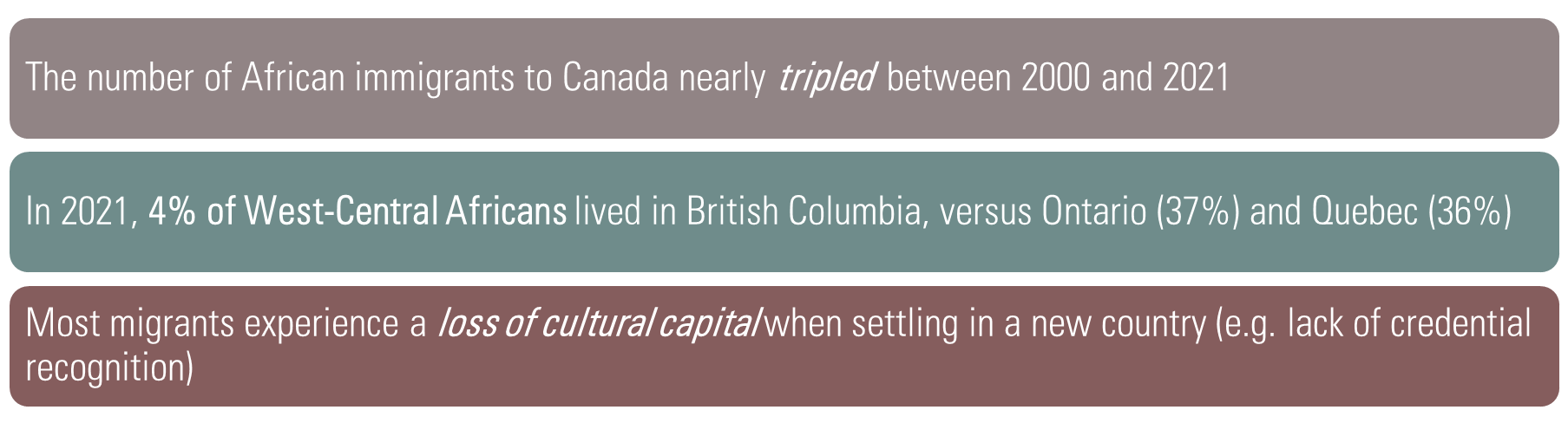
(Government of Canada, 2017, 2023; Lindsay, 2001; Este, 2018; Statistics Canada, 2013; 2023; Huot, 2016; Wilcock, 2004; Ryan, 2011)
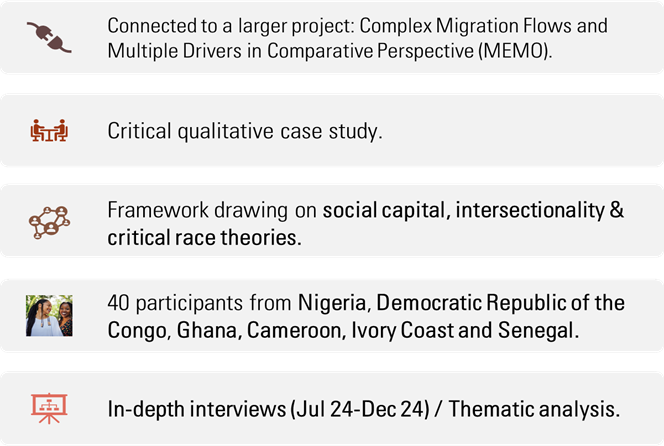
Our study
How can we define hospitality?
- Hospitality was defined by Balch (2016) as a social concept to welcome a new person, between community members, families and countries.
- In the field of migration studies, research adopting this concept refer to the welcoming nation as “host” and to the newcomer as “guest” (Araya-Moreno, 2020; Derrida, 1999; Balch, 2016; Rosello, 2001)
- Piquemal et al.’s study (2023, 2009) examined how newcomers perceive acceptance and welcoming through their lived experiences; they underlined power dynamics in hospitality with the ‘host’ country’s population trying to be the homeowner-ruler and the migrants trying to feel at home.
- The origin of hospitality in Africa is often linked to:
- The identification of people as members of a community, rather than an emphasis on individualism (Gathogo, 2013)
- Ubuntu (Universal, Behaviour, United, Negotiation, Tolerance and Understanding) (Tutu, 2004; Moloketi, 2009), meaning “Umuntu Ngumuntu Ngabantu” (a person is a person because of or through others) (Moloketi, 2009, p. 243; Tutu, 2004, pp. 25-26). Across Africa, countries have similar definitions of hospitality with local specificities (e.g., téranga in Senegal)
- Our research metaphor, the baobab tree, symbolizes:
- The resilience of interconnected West-Central African migrants who “root in” their new home
- A low barrier inclusive gathering place, and
- A continuous interaction with a lessen power relationship between the immigrant and the destination country’s population.
Key findings
Experiences of hospitality at the border
Ooh Canada 🍁
Several participants, such as Femi, reported a positive first experience in Metro Vancouver. She stated:
“To have your stamp on your permanent residency document, and (when the border officer tells you) ‘you are welcomed’, ‘congratulations’ and everything, I said to myself. What’s going on here, it’s a party in that country. I think that all these little experiences, frankly, they still play on how we apprehend our experience here and what we, finally, feel. Because you can always have a miserable work experience in any country. But I think all these little details actually make the atmosphere more relaxed. In any case, we have a more positive view of our environment.”
(Femi, female, 35-54 years old, from Senegal)
Experiences of hospitality in the workplace
“Level wise and pay wise, …those two things did not match”
However, many participants, including Aida, experienced barriers in obtaining employment aligned with their academic qualifications and prior experience. She shared:
“The level I was, was like the equivalent of an almost manager-ish. So when I saw the role, it was like a senior analyst. [….] so was it the pay I wanted? No, but I took it because I was really ready to move. I just wanted to start my life here with the kids and settle. [….] I felt this pressure to take the job because I was like, you know what? And when I spoke to a couple of people, like, you know, take what you get first, once you’re in the system [….] So my experience really relates very directly with the job, but level wise and pay wise, it wasn’t … those two things did not match.”
(Aida, female, 35-54 years old, from Nigeria)
Hospitality from postsecondary institutions
“Until today, she is not enrolled in the university”
Additionally, number of parent participants indicated that their children encountered challenges in navigating the educational system. For example, Assane reported:
“Yes, it’s complicated. The first challenge is precisely the registration of the children at university, because we came here with our children who had already… They were in school. Well, the one, who is still small, we easily integrated him into the secondary school, because he is English-speaking. But enrolling in universities here is really complicated. For example, my daughter, she’s 18 years old, she got the baccalaureate, and she arrived here, it was complicated. They say she does not speak English…”
(Assane, male, 65+ years old, from Cameroon)
Contributions / Recommendations
- Our study helps extend conceptualizations of hospitality and its application, to foster greater hospitality towards the inclusion of immigrants from West-Central Africa in Metro Vancouver by informing policies and programs.
- Key recommendations emerging from the findings include needing to improve the welcome system and the continuum of services for immigrants; promoting more interaction between people born outside Canada and the ones born in Canada; and strengthening hospitality in employment and educational institutions.
References
Araya-Moreno, J. (2020). What does Hospitality Look Like when Immigrants are ‘wanted’? The Case of the Immigration Selection Process in Quebec, Canada. Hospitality & society , 335-350.
Balch, A. (2016). Immigration and the State. UK: Palgrave Macmillan.
Derrida, J., & Dufourmantelle, A. (2000). Of Hospitality. Stanford, CA:: Stanford University Press.
Este, D. (2018). African Canadians: “Still in search of the promised land”. In S. &. Guo, Immigration, racial and ethnic studies in 150 years of Canada : retrospects and prospects (pp. 56-60). Brill Sense.
Gathogo, J. M. (2013). SOME EXPRESSIONS OF AFRICAN HOSPITALITY TODAY. Scriptura, 99(0), 275, 275.
Government of Canada. (2017, October 25). Immigration and ethnocultural diversity Highlight Tables, 2016 Census. Retrieved from https://www12.statcan.gc.ca: https://www12.statcan.gc.ca/census-recensement/2016/dp-pd/hlt-fst/imm/index-eng.cfm
Government of Canada. (2023, May 10). Religion by ethnic or cultural origins: Canada, provinces and territories and census metropolitan areas with parts. Retrieved from Www150.Statcan.gc.ca: https://www150.statcan.gc.ca/t1/tbl1/en/tv.action?pid=9810034101
Huot, S., Kelly, E., & Park, S. J. (2016). Occupational experiences of forced migrants: A scoping review. Australian occupational therapy journal, 63(3), 186–205.
Lindsay, C. (2001, April 3). Profiles of Ethnic Communities in Canada The African Community in Canada. Retrieved from https://www150.statcan.gc.ca:
MEMO. (2024, May 31). Toronto Metropolitan University. Retrieved from https://www.torontomu.ca: https://www.torontomu.ca/memo/
Moloketi, G. R. (2009). Towards a common understanding of corruption in Africa. Public Policy and Administration, 24(3), 331-338.
Piquemal, N., & Bolivar, B. (2009). Portraits d’immigrants francophones en milieu minoritaire. Journal of International Migration and Integration/Revue de l’integration et de la migration internationale,, 10:3, pp.245–64.
Piquemal, N., Zellama, F., & Sall, L. (2023). Multicultural hospitality and immigration in Winnipeg, Manitoba: Host–guest dynamics. Hospitality & society, 41-62
Rosello, M. (2001). Postcolonial hospitality: The immigrant as guest . . Stanford : Stanford University Press.
Ryan, L. (2011). “Migrants’ Social Networks and Weak Ties: Accessing Resources and Constructing Relationships Post-Migration.” . The Sociological Review , 59 (4): 707–24
Statistics Canada. (2013). Immigration and Ethnocultural Diversity in Canada Analytical document. Retrieved from Immigration and ethnocultural diversity in Canada : national household survey 2011: https://www12.statcan.gc.ca/nhs-enm/2011/as-sa/99-010-x/99-010-x2011001-eng.pdf
Statistics Canada. (2023, November 15). Census Profile, 2021. Census of Population. Retrieved from Www12.Statcan.gc.ca: https://www12.statcan.gc.ca/census-recensement/2021/dp-pd/prof/index.cfm?Lang=E
Tutu, D. (2004). God has a dream: A vision of hope for our future. London: Rider.
Wilcock, E. T. (2004). Occupational justice and client-centred practice: a dialogue in progress. Canadian Journal of Occupational Therapy, 75–87.
Funding support: SSHRC Partnership Grant, SSHRC Doctoral Award, CGS-MSFSS
Contact: astou.thiam@ubc.ca or suzanne.huot@ubc.ca